Ascendant in Aquarius: distance, originality and your own kind of company
How Aquarius rising makes first contact: peer-to-peer interest, a half-step of distance, originality as a shield, and the negotiation of belonging.
Natalchart
A closer look at birth charts, relationships, and the ideas that connect them.
How Aquarius rising makes first contact: peer-to-peer interest, a half-step of distance, originality as a shield, and the negotiation of belonging.
With Aries on the Ascendant, the first sentence and the first move arrive together. On speed that is mistaken for anger, and on aiming the Mars impulse somewhere it can be useful.
With Cancer on the Ascendant, you find the edge of the room before you join it. On a warm entrance that looks cautious, and on where care ends and self-protection begins.
How Capricorn rising makes first contact: the measured greeting, the dry joke, the practical help, and the slow permission to be informal.
Gemini on the Ascendant opens with a question, a joke or a remark. On a lively mind that gets mistaken for shallowness, and on what to do when the conversation goes quiet.
A Leo Ascendant describes a visible, warm entrance and a real need for response. This reading follows the recognition loop, the moment warmth becomes a performance, and the Sun as chart ruler.
A Libra Ascendant describes an attuned, charming entrance: the person mirrors the other, smooths the room and delays refusal. This reading follows the social skill, the cost of the postponed no and Venus as chart ruler.
How Pisces rising makes first contact: attunement, chameleon adaptation, the boundary problem, and empathy that does not erase the self.
How Sagittarius rising makes first contact: the wide gesture, the joke, the promise, and the follow-through. No travel or luck forecast.
A Scorpio Ascendant describes a contained, testing entrance: the person observes, asks little and lets others in slowly. This reading follows the watchful manner, the slow build of trust and the difference between privacy and control.
With Taurus on the Ascendant, first contact arrives through the senses and a check of the floor underfoot. On slowness that reads as coldness, and on what this sign will actually move for.
A Virgo Ascendant describes an observant, useful entrance: the person arrives through a task, notices what needs adjusting and offers help. This reading follows the scan, the service-first warmth and the risk of inspecting the other person.
With the Moon in Aquarius, closeness needs room inside it. Feeling is often understood through thought and friendship, and the retreat that protects you can read as indifference unless you name it.
With an Aries Moon, a need arrives as an instruction to act. Here is why ambiguity drains you faster than a frank conversation, how to keep a request from becoming an emergency, and what it means to come back after the heat.
With a Cancer Moon, you need to know your place in someone's life will not be cancelled. Here is how emotional memory works, why a request for care arrives as a hint, and how to get through the low tide without testing anyone's loyalty.
With the Moon in Capricorn, safety is built from dependability. Feeling waits for a safe moment, care is proved by showing up, and trust grows through consistency rather than declarations.
With a Gemini Moon, a feeling becomes clearer once it has a name. You need a mind to think with — a friend, a question, a voice note, a notebook — not as distraction but as the route through. Here is what to do when the words will not stop.
With the Moon in Leo, warmth arrives through being specifically seen. Generosity is real, but it can become a quiet ledger; hurt often wears pride. The work is to ask for the particular acknowledgement instead of waiting to be noticed.
With the Moon in Libra, balance is relational: another person's mood arrives before your own preference. Diplomacy is a real skill, but it can turn into self-abandonment. The practice is to name one preference early and say the irritation while it is still small.
With the Moon in Pisces the border between self and atmosphere is thin. Feeling arrives through the room, quiet is a need rather than a rejection, and care has to keep a limit or the carer disappears.
With the Moon in Sagittarius, hope and forward motion are emotional infrastructure. The work is telling a wide view apart from an exit, and making promises your calendar can keep.
With the Moon in Scorpio, trust is watched before it is given. Privacy protects a deep emotional life, and intensity can turn into testing or control. The way through is plain language about the fear and one specific request for reassurance.
With a Taurus Moon, calm arrives through the familiar: food, touch, routine and a person who does what they promised. Here is why sudden change can land harder than its size suggests, and how to tell a solid base from a refusal to move.
With the Moon in the eighth house, intimacy is not a bonus but a need. You want to be fully known, trust is the real currency, and the risk is controlling what you are afraid to lose.
With the Moon in the eleventh house, friends become chosen family. What matters is not the size of the circle but the sense of being held, and the risk is agreeing to keep your place in it.
With the Moon in the fifth house, pleasure regulates mood. You need play, romance and something of your own to make, and the work is to enjoy it without waiting for an audience.
With the Moon in the first house, mood arrives before words. The need is not applause but a live response, and the work is to stay open without taking on every atmosphere you walk into.
With the Moon in the fourth house, belonging is infrastructure. You need a place to exhale, care by making room for others, and learn which parts of the past are a foundation and which are an old script.
With the Moon in the ninth house, you breathe more easily when there is a horizon: another country, a big idea, a course of study. The need for meaning is real; the question is whether it leads you into your life or past it.
With the Moon in the second house, safety has a texture: a full shelf, a known taste, a place that is yours. The placement describes care through providing, and the risk of asking objects to do emotional work.
With the Moon in the seventh house, companionship regulates your state. You need a witness, tune closely to a partner, and risk mistaking the fear of being alone for love.
With the Moon in the sixth house, daily rhythm is emotional support. You feel safe when the day has shape and your help is concrete, and the risk is making yourself indispensable so you never have to feel unneeded.
With the Moon in the tenth house, a public role becomes an emotional home: you want your work to be seen and answered. The need is real, and so is the risk of letting other people's approval set your inner weather.
With the Moon in the third house, a feeling becomes manageable once it has words. Memory keeps the tone of a conversation, and the near circle is the first emotional map you learn to read.
With the Moon in the twelfth house, feelings arrive late and need quiet. Solitude restores you; the work is not to mistake chosen silence for isolation.
With the Moon in Virgo, safety is built from order and usefulness. Care shows up as practical attention, and the same eye can become an inner critic. The adjustment is to ask for plain appreciation and shrink the next step to something physical.
With the Sun in the eighth house, identity is sought in depth, intimacy and the ability to pass through what cannot be controlled. On the strength a turning point can produce, the price of control, and how to trust without losing yourself.
The Sun in the eleventh house steers the will through belonging: a circle, a cause, a shared picture of the future. On chosen kinship, leading without domination, the silence that loyalty can buy, and what remains of you when the circle changes.
With the Sun in the fifth house, creativity becomes a way of putting yourself into the world: you need to make something of your own and see how it lands. On the mature form of that need, on love and falling for a reflection, and on keeping authorship when the audience reacts.
With the Sun in the first house, will sits on the front edge: your presence and first move need to be yours rather than a convenient role. On the mature form of that need, the cost of living on other people's reactions, and putting visibility to work.
The Sun in the fourth house looks for a private foundation for will: a place to act from before facing the public. On home as permission rather than address, inherited expectations, chosen foundations, and why maturity sometimes arrives later.
The Sun in the ninth house directs the will through meaning: a horizon, a conviction, a wider map. On why the big idea comes first, what travel and study actually provide, teaching from an unfinished place, and the difference between expansion and escape.
The Sun in the second house ties will to resources and values: this person trusts what can be touched and counted. On the difference between earning and proving, taste as a form of will, and what remains of self-esteem when resources shrink.
With the Sun in the seventh house, someone close becomes confirmation, challenge and mirror: your desires sharpen in their presence, and so does the risk of giving them the pen. On negotiation as a way to find direction, on projection, and on staying yourself inside a union.
With the Sun in the sixth house, the centre of identity moves into daily work: you respect yourself when the day has shape, the task is finished and the usefulness is visible. On the dignity of routine, the line between work and self, and how not to dissolve into a function.
The Sun in the tenth house ties identity to public authorship: what you build, answer for and are known by. On ambition versus proof, learning authority, public failure, the long build, and the private base that keeps the role from becoming the whole person.
The Sun in the third house turns speech, learning and everyday exchange into a way of becoming yourself: you find out what you think at the moment you formulate it. On speed versus depth, the near circle as a first mirror, and the value of silence.
The Sun in the twelfth house forms identity offstage: in solitude, imagination, compassion and work nobody sees. On quiet as a method, the difference between chosen solitude and hiding, and bringing the inner life back to people without losing its depth.
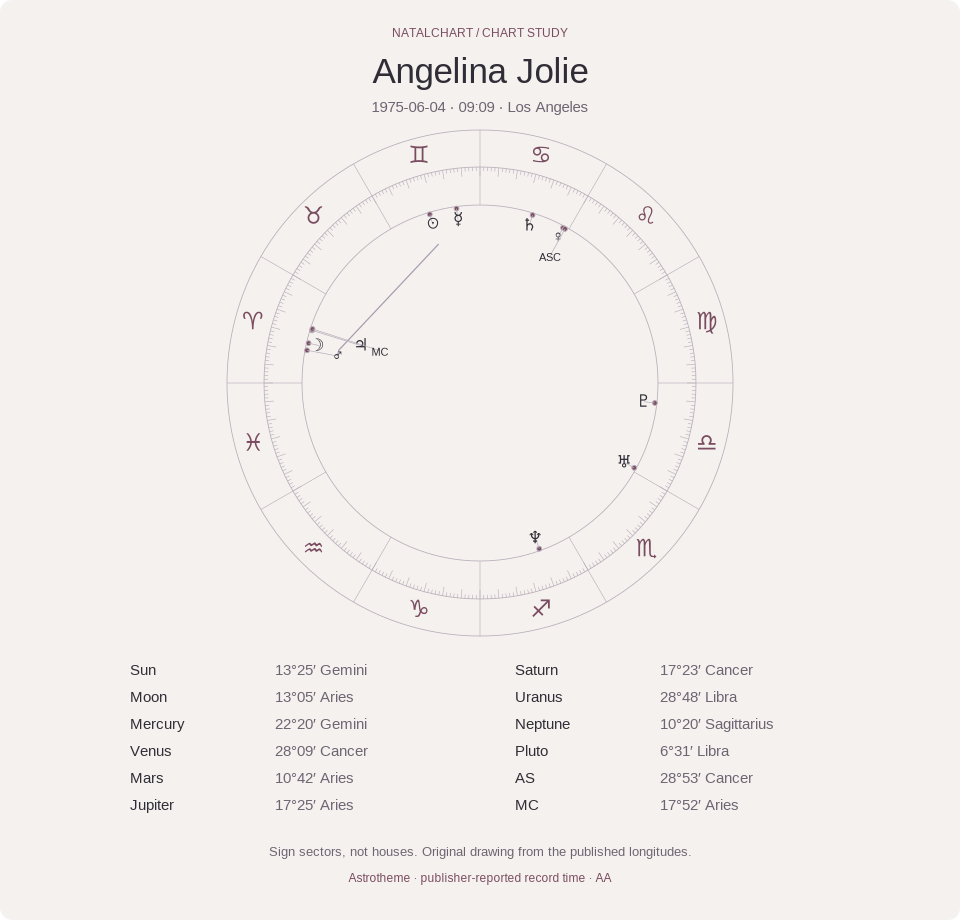
Her reported chart pairs a Gemini Sun with an Aries Moon and Cancer rising. A reading of the fast mind, the emotional reflex and the guarded way a room is met.
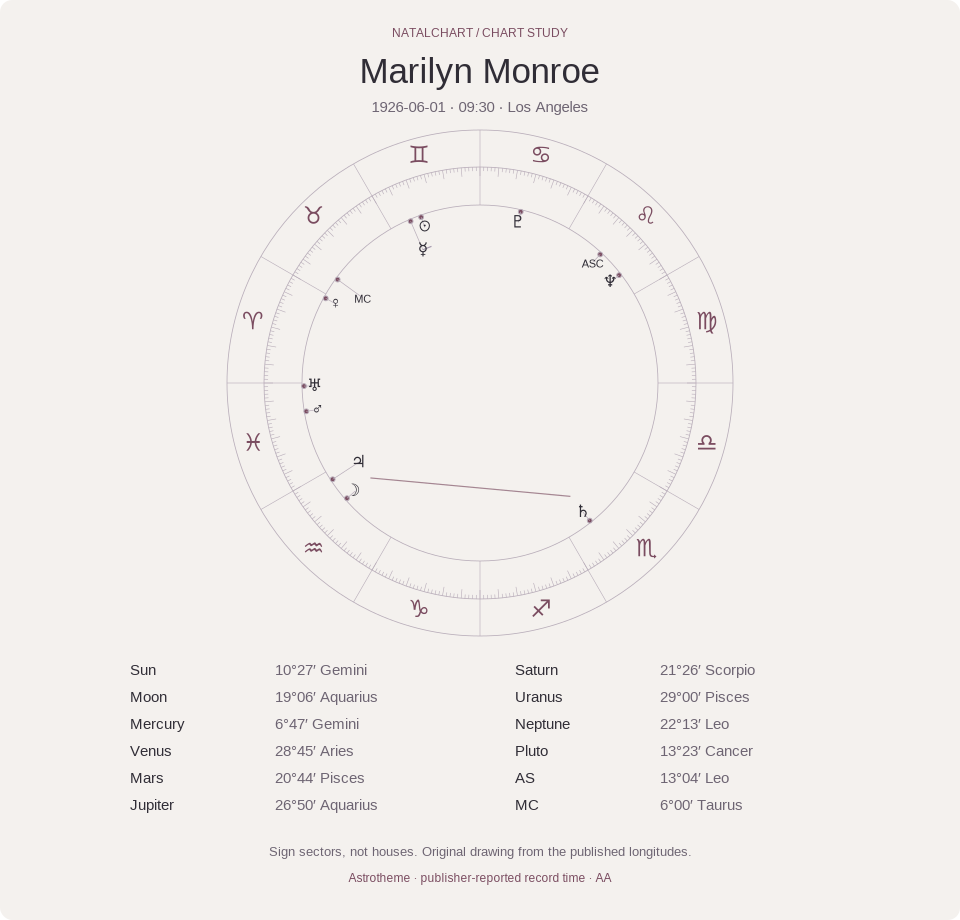
Her reported chart sets a sociable Gemini Sun and Leo ascendant against an Aquarius Moon. A reading of the public manner, emotional distance and two linking aspects.
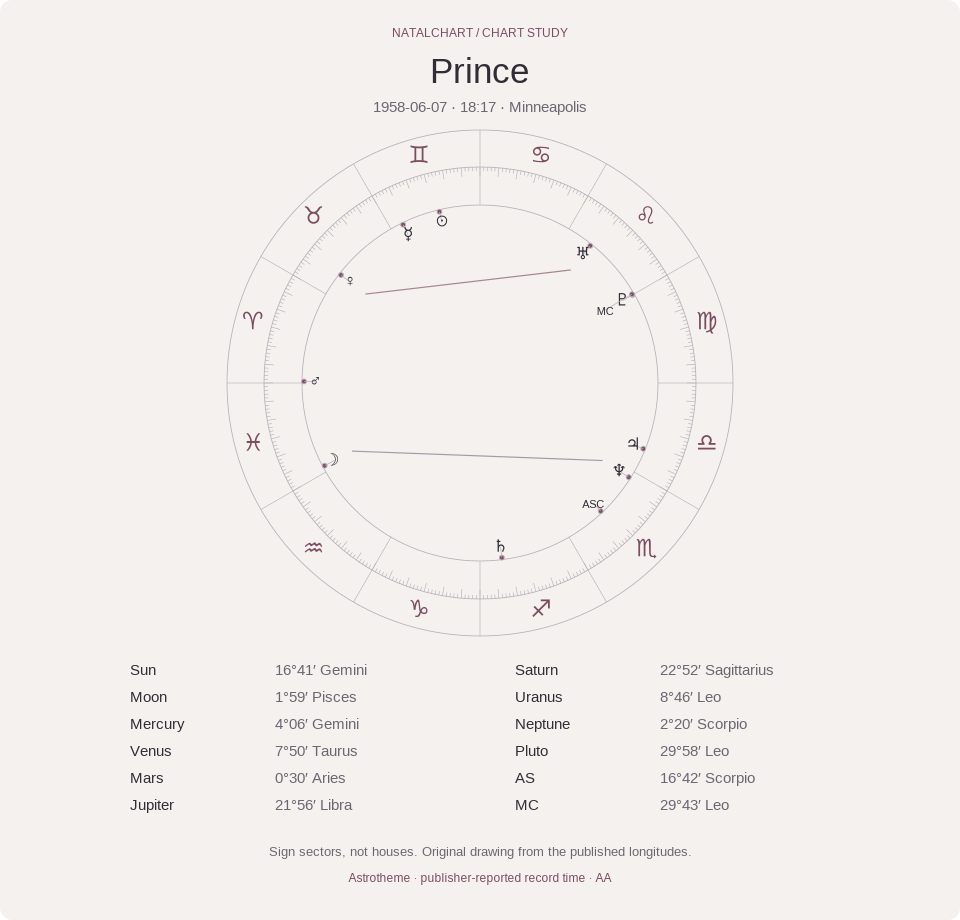
His reported chart has the Sun in Gemini, the Moon in Pisces and Scorpio rising. A reading of speed, receptivity and privacy, with two aspects that connect them.
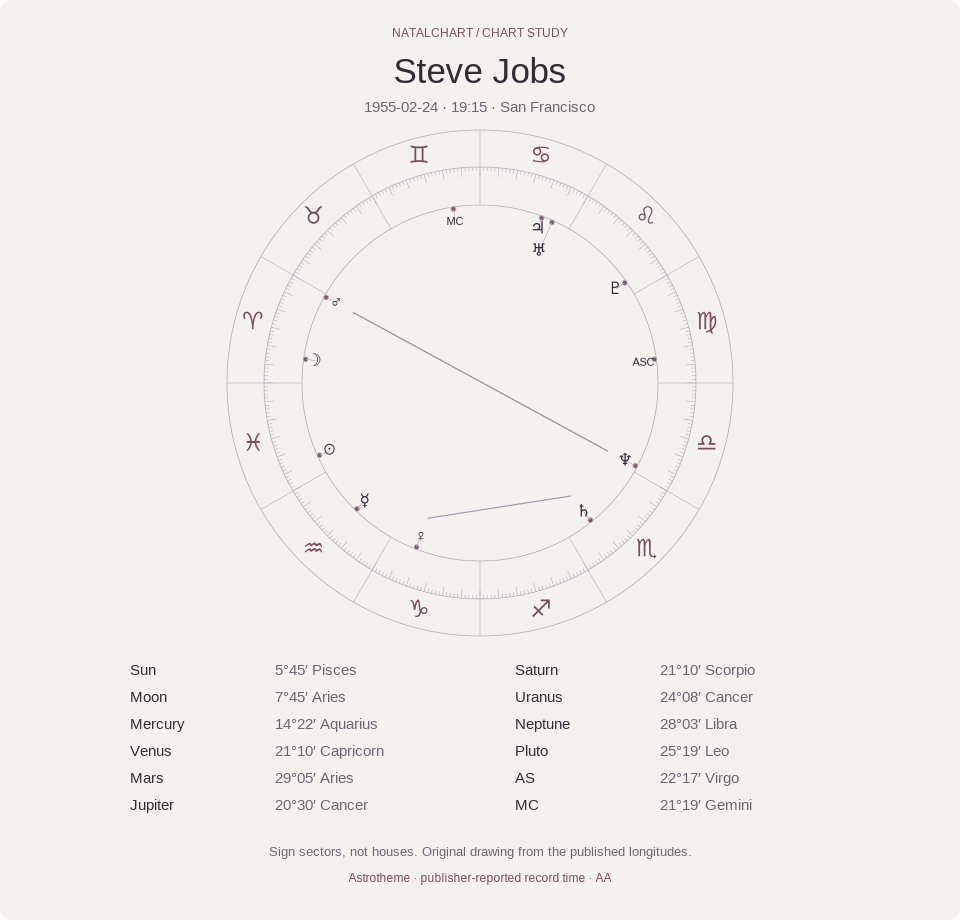
His reported chart pairs a Pisces Sun with an Aries Moon and Virgo rising. A reading of imagination, speed and discernment, with two aspects that hold them together.
Planets in conjunction are read together. Their closeness highlights a shared theme, without making the connection automatically harmonious or the strongest aspect.
Last quarter, new moon, first quarter and full moon: the month's four primary phases in UT. A phase is an instant in the lunar cycle, not a whole evening or a forecast.
An opposition connects two poles of a chart. A Sun–Moon example shows how to read different needs without turning a natal aspect into a compatibility score.
A sextile describes a connection through which planetary meanings can support each other. A Venus–Moon example shows what that means beyond a simple luck rating.
A square brings a conflict between planetary meanings into a reading. Its expression varies: the aspect alone does not define someone’s character or determine an outcome.
A trine describes cooperation between two planetary meanings. It can become a familiar background, making it useful to ask which planets are connected and what they support.
Two people, two charts and the contacts between them. Synastry is a way of organising a comparison, not a scoreboard for the relationship or a verdict about it.
The same birthday is not the same instant. Time zone, coordinates, zodiac reference, house method and orb settings all change the result — so compare the inputs before comparing the charts.
Without an exact time, a chart stops being one set of positions. How to find what holds across the whole interval, and how to label the rest honestly.
How Aquarius approaches life and close relationships, with a look at its strengths, tensions, everyday care and selected sign pairings.
Aries moves first and speaks plainly. Discover the strengths behind that energy, where impatience gets in the way, and how this fire sign approaches love and partnership.
Target angle, actual separation and orb are three different quantities. The formula is shown on a square example, a 0°/360° example and the settings that change a chart.
Signs tell you where a planet stands; houses tell you where its story plays out. The grid depends on birth time and place, and one planet can change house when the system does.
A precise coordinate does not prove a meaning, and an interpretation does not become a measurement. We walk through five steps with one longitude and practise telling a testable question from a persuasive judgement.
Cancer notices the feelings behind a conversation and remembers the details that matter. Explore its care, reserve and relationship needs, alongside opposite sign Capricorn.
How Capricorn approaches life and close relationships, with a look at its strengths, tensions, everyday care and selected sign pairings.
Each sign is the intersection of an element and a modality. The full table is shown, rebuilt from its logic, and separated from chart counting or temperament scoring.
Gemini thrives on conversation and discovery. Explore how that curiosity shapes work and love, where too many options become a problem, and what helps a relationship last.
A house system changes the grid of a chart, not the positions of the planets. Three methods are compared on one degree, and the answer depends on more than the method.
Six steps from birth data to a single interpretive sentence, with a sample annotation, a worked example and a short check.
Jupiter is the chart's factor for growth, belief and the search for meaning. The house marks where offers and mentors cluster, the sign sets the style of expansion, and aspects show what the growth serves. Why more does not always mean better.
How Leo approaches life, love and close relationships, with a look at its strengths, tensions and selected sign pairings.
How Libra approaches life, love and close relationships, with a look at its strengths, tensions and selected sign pairings.
An aspect is an angular relationship between two chart points close to one of five angles. We work through the 0°/360° case, the role of the orb and one invented Moon–Saturn pair.
Mars is the chart's factor for action, assertion and anger. The house names the arena, the sign sets the manner, and aspects show what the push is wired to. Why anger is a signal rather than a verdict.
Mercury is the chart's factor for sorting information, phrasing it and passing it on. This guide separates mental style from intelligence, explains why speech and writing are different channels, and keeps the Mercury function apart from the third house.
MC and IC form the vertical axis of a chart. We explain why the MC is not the zenith or always the tenth cusp, and how the same point changes house with the system.
Neptune marks where imagination and compassion make an image feel more real than the evidence, and where your own feeling is harder to separate from someone else's. Inspiration and disillusionment are one function, not two stories.
How Pisces approaches life and close relationships, with a look at its strengths, tensions, everyday care and selected sign pairings.
Astronomical classes and astrological groups do not match. How the luminaries, personal and outer bodies are grouped, and how to build one hypothetical sentence.
Pluto marks the field where a person meets force and dependency, holds control or loses it, and has to reassemble the terms. The sign is shared by a generation; the house and contacts with personal bodies make the field personal.
How Sagittarius approaches life and close relationships, with a look at its strengths, tensions, everyday care and selected sign pairings.
Saturn is the chart's factor for limits, deadlines and responsibility. The house marks the area where shortcuts fail, the sign the manner of effort, and aspects what the limit is attached to. No promised reward, no fixed age.
How Scorpio approaches life, love and close relationships, with a look at its strengths, tensions and selected sign pairings.
The Sun, Moon and ascendant answer different questions and depend on different data. An invented combination shows what houses, aspects and settings add.
Taurus values a dependable rhythm and everyday pleasure. Explore the strengths behind that steadiness, the resistance to change and the way this sign shows affection.
The rising point depends on time and place and anchors the houses. We separate the point from the rising sign, explain Whole Sign cusps and show how to check birth time across an interval.
The eighth house begins with ordinary shared life: a joint account, a loan, a tax bill, a separation. It describes how people handle what they cannot own alone — and why trust can feel like a risk.
The eleventh house describes not how many friends you have but the quality of chosen belonging. It shows the place you take in a group, the hopes you share with others, and where a collective stops being support.
The fifth house describes what you make and enjoy for its own sake, from a silly joke to a serious creative practice. It is not a fertility forecast or a talent certificate.
The first house is not your whole personality. It is the interface: how you enter a room, start a conversation and what people read before they know you. The Ascendant sets the tone, and its ruler shows where that story continues.
The fourth house covers more than walls and relatives. It describes the emotional weather of childhood, the place where you feel you belong, and the home you make as an adult. The IC is its angle; the cusp sign and ruler show how the theme is put together.
The Moon is the chart's factor for reflex and felt security — what you do before deciding and what restores you. This guide covers its privacy, the birth-time problem, sign, house and aspects, with one clearly constructed example.
The ninth house begins where familiar facts stop being enough. It describes not a holiday or a degree, but the way a person assembles meaning — and where that meaning gets tested.
The second house asks what you have and how you hold it. It covers income patterns, possessions, skills, time and the internal scale of value. Read it as a relationship to resources, not a forecast of wealth, and pair it with the eighth house of shared money.
The seventh house describes the people you face one to one: partners, clients, collaborators and opponents. It is not a marriage guarantee, and the Descendant is not a photograph of your future spouse.
The sixth house describes the texture of ordinary days: the tasks, colleagues, skills and small acts of care that keep a life in working order. It is not a career forecast or a diagnosis.
The Sun is the chart's factor for conscious direction and authorship. This guide looks at why recognition can nourish or irritate, what sign, house and aspects add, and where the solar story ends.
The tenth house connects vocation, reputation and public responsibility. Learn how its cusp and ruler relate to the MC, and why this house is read alongside the fourth.
The third house describes the style and speed of everyday exchange, not a grade for intelligence. It covers how you talk, write, remember and pick up practical skills, along with the near circle of siblings, neighbours and classmates and the routes you travel every day.
The twelfth house describes what happens when a person steps out of the social current. It is not a verdict or a diagnosis, but a space for recovery, imagination and work with what has not yet become words.
The same point in the sky gets a different longitude and a different sign when the reference zero changes. How ayanamsha works, and why the planet itself stays put.
Uranus marks where inherited rules stop fitting and where a person needs room to move by their own route. Its sign is shared by a cohort; its house and contacts with personal bodies make the theme personal.
Venus is the chart's factor for what registers as valuable, pleasant and worth keeping. This guide separates liking from wanting, looks at the different forms affection takes, and shows what sign, house and aspects add.
How Virgo approaches life, love and close relationships, with a look at its strengths, tensions and selected sign pairings.
A chart shows where the Sun, Moon and planets stood at a chosen moment. A guide to its parts, a sample notation, and the line between calculation and tradition.
A natal chart is cast for one moment and one place. Those inputs decide which positions are known exactly and which stay approximate — and how to say so without pretending.
Twelve signs and thirteen constellations along the Sun's path are different systems. A guide to the ecliptic, sign boundaries, Ophiuchus and one angular exercise.